SiteScout — UK food-establishment intelligence.
Five productised packages for owners, property advisors, chains and franchisors. Built on a curated UK food universe, fine-grained official neighbourhood-level demographics (~200 households per zone), and real road-network drive-times. The engine is an established retail-planning gravity model — first published in the 1960s — applied at finer geography than anything publicly available.
One cleaned universe. One demand engine. Five deliverables.
Every package reads from the same backbone: a curated UK food universe, building footprints as venue size, drive-time distances to nearly 190,000 fine-grained neighbourhoods, and a gravity-based demand model that turns the lot into per-neighbourhood capture probabilities.
Cleaned universe
Raw open geospatial data is noisy — bingo halls, parcel-pickup points, school canteens, hospital cafeterias and supermarket host buildings all contaminate naive top-10 lists. We exclude them, tag what remains, and reconcile re-issued IDs across data refreshes.
Gravity-based demand model
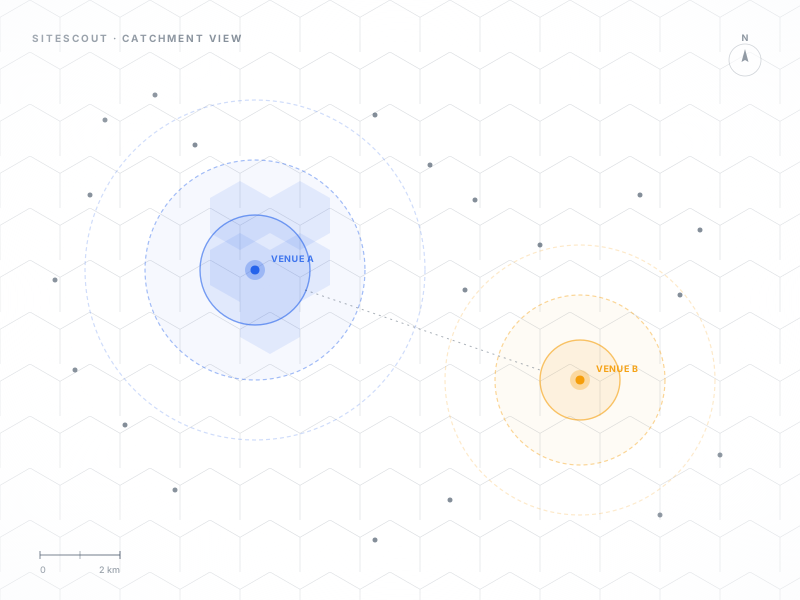
For every fine-grained neighbourhood within reach of a venue, we compute the probability a resident picks that venue, weighted by venue size and real road-network drive-time. Probability × population gives expected demand at neighbourhood resolution.
Deliverables, not platforms
HTML reports, PDFs, Excel workbooks, interactive maps. No software to install. No platform licence. Every report carries a lineage panel — data refresh, model run, date — so a stale report is identifiable at a glance.
Five packages, one demand engine.
All five are built on one cleaned UK food-outlet universe and one demand-modelling engine. The same building blocks compose into deliverables shaped for indie owners, property advisors, and multi-site chains. Pricing is bespoke to scope — tell us what you're trying to decide and we'll point you at the right package with a quote.
P1 — Single-Site Catchment
"How good is my current site, really? Who am I competing with? Where do my customers actually come from?"
A pub owner looks at her quarterly P&L and wonders whether the lull is the macro environment, her menu, or the new burger place that opened in the next postcode. A property advisor pitching her landlord wants a defensible answer to "is this still a strong unit". Today she can stare at Google Maps and count blue dots; that doesn't tell her about demand.
Buyer: indie owners (1–3 sites). Property advisors white-labelling for client briefings. Chains as a teaser.
P2 — Market Pulse
"Who's opening near me? Who's closing? Is the high street getting better or worse for my category?"
A chain ops director needs to know within a week when a competitor opens across the road from one of her thirty sites. A property advisor wants a quarterly newsletter with credibility — content their clients will actually read and forward.
Buyer: chains (10–200 sites). Property advisors at regional or national scale.
P3 — Site Shortlist
"Where should I open my next cafe, restaurant or takeaway? Give me a ranked list of micro-locations, not a vague heat-map."
A coffee chain's expansion director has a capital budget to deploy across the next 12 months. She has guesses about which towns; she needs candidate units. A property advisor pitching to a franchise developer wants thirty ranked addresses, not thirty ranked postcodes.
Buyer: multi-site chain expansion teams. Property advisors and franchise developers building briefing decks.
P4 — Chain Audit + Cannibalisation
"How do my own sites compare? Where do they steal demand from each other? Which underperform their catchment? If I closed site X, how much would site Y recover?"
A chain ops director suspects three sites underperform but can't quantify it independently of menu, manager, or marketing. A franchisor wants to see whether new sub-franchises are eating their own incumbents. A franchisee wants to challenge their territory allocation with hard data.
Buyer: chains (10–500 sites). Franchise networks — franchisors auditing the network and franchisees challenging territory.
P5 — Hypothetical Site Impact
"If I open at this address, what's my expected capture? How much do I cannibalise my existing site at the next postcode? How much do I take from competitors? What if it's a swap-out — close my current unit and open at the new lease?"
A chain ops director has a lease offer on the table — a six-figure decision. A property advisor is pitching her client one of three shortlisted locations. A franchisee is asking the franchisor to evaluate a proposed second unit. The status quo for this decision is gut feel and drive-time intuition; we can do better.
Buyer: chains evaluating a specific lease. Property advisors building site-recommendation decks for clients. Franchisors and franchisees negotiating new territories.
Something else?
If your decision doesn't fit cleanly into one of the five packages — bespoke geographies, white-label work, sector adaptations, ongoing retainers — tell us what you're trying to answer and we'll shape an engagement around it.
Buyer: anyone whose question is the shape of "kind of like P3, but…".
Honest about what the model does — and doesn't.
What's in V1
- England and Wales coverage (Scotland and Northern Ireland on the roadmap)
- Neighbourhood-resolution capture probabilities — an order of magnitude finer than public postcode-level alternatives
- Real drive-time distances over the GB road network (not as-the-crow-flies)
- Longitudinal record of every venue's first-observed and last-observed dates
- Methodology appendix with every report — so the buyer can defend the rankings under scrutiny
What we're up-front about
- Headline capture is a relative visit-intensity index — £ requires the calibration uplift
- Demand is total population, not income- or spend-weighted (demographic weighting is a roadmap item)
- Drive-times are free-flow, not rush-hour congestion-weighted
- Shortlists narrow hundreds of options to dozens; lease economics, planning and traffic still need a site visit
Want a sample report, or a quote for a specific tier?
Tell us the package and the scope. We'll come back with a sample deliverable and a quote within a working day.